SPEDIZIONE GRATIS
con corriere veloce per acquisti oltre 29,00 €.
Pagabile anche con Carta della cultura giovani e del merito, Carta della Cultura e Carta del Docente
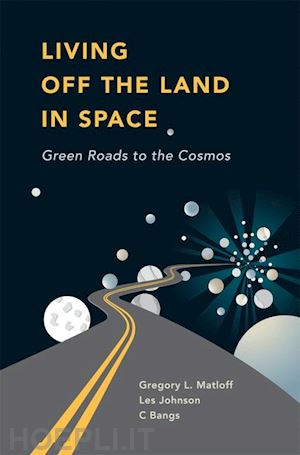
Human civilization has evolved to the point at which we can consider tapping space resources and expanding beyond Earth’s atmosphere. The Introduction surveys possible motivations for large-scale human emigration to space. Since our early ancestors began to move out of Africa, humans have constantly expanded their range. Today, the pattern of human settlement extends from pole to pole. Humans regularly visit the upper troposphere and ocean floor and technology has enabled a few to even reside above the atmosphere in space stations.
For the next few millennia at least (barring breakthroughs), the human frontier will include the solar system and the nearest stars. Will it better to settle the Moon, Mars, or a nearby asteroid and what environments can we expect to find in the vicinity of nearby stars are questions that need to be answered if mankind is to migrate into space.
At present, Dr Matloff teaches physics and astronomy as an Assistant Professor at New York City Technical College, CUNY. He has pioneered the application of gossamer spacecraft to deep-space exploration and has served as a Faculty Fellow in summer 1999, 2000 and 2001 at NASA Marshall Spaceflight Center (MSFC), Huntsville AL. He has participated there on a design team planning interstellar missions propelled by solar sails unfurled Sunward of the Earth. He consults for NASA through Gray Research and Teledyne Brown, in Huntsville AL.
Les Johnson manages the Science Programs and Projects Office at NASA's Marshall Space Flight Center. In addition to his NASA credentials, Johnson also is an inventor. He holds three patents, including one received in 1989 for a laser-triggered, fiber-optic neutron detector. His most recent patent was awarded in July 2003 for an electrodynamic sail for propulsion. Johnson is also a two-time recipient of the NASA Exceptional Achievement Medal.
Ms Bangs’ work is in many permanent collections, including MSFC, the US Library of Congress, the Mint Museum and the Chrysler Museum.


Il sito utilizza cookie ed altri strumenti di tracciamento che raccolgono informazioni dal dispositivo dell’utente. Oltre ai cookie tecnici ed analitici aggregati, strettamente necessari per il funzionamento di questo sito web, previo consenso dell’utente possono essere installati cookie di profilazione e marketing e cookie dei social media. Cliccando su “Accetto tutti i cookie” saranno attivate tutte le categorie di cookie. Per accettare solo deterninate categorie di cookie, cliccare invece su “Impostazioni cookie”. Chiudendo il banner o continuando a navigare saranno installati solo cookie tecnici. Per maggiori dettagli, consultare la Cookie Policy.