libri scuola books Fumetti ebook dvd top ten sconti 0 Carrello


Torna Indietro
ARGOMENTO:  BOOKS > STORIA E SAGGISTICA

morley morris h. - imperial state and revolution
Zoom

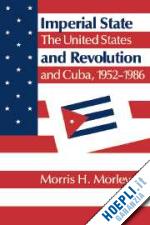
Imperial State and Revolution The United States and Cuba, 1952–1986


Disponibilità: Normalmente disponibile in 20 giorni
A causa di problematiche nell'approvvigionamento legate alla Brexit sono possibili ritardi nelle consegne.


PREZZO
52,98 €
NICEPRICE
50,33 €
SCONTO
5%


Questo prodotto usufruisce delle SPEDIZIONI GRATIS
selezionando l'opzione Corriere Veloce in fase di ordine.


Pagabile anche con Carta della cultura giovani e del merito, 18App Bonus Cultura e Carta del Docente


Facebook Twitter Aggiungi commento


Spese Gratis

Dettagli

Genere:Libro
Lingua: Inglese
Pubblicazione: 01/1988


Trama

Drawing on personal interviews, classified documents obtained through the Freedom of Information Act, and other primary sources, this study presents the most comprehensive analysis to date of the Kennedy and Johnson administrations' efforts to isolate Cuba politically within Latin America and economically throughout the capitalist world.


Note Editore

The United States played a decisive role in Cuba's political and economic development during the first half of the twentieth century. The emergence in the 1950s of a broad-based opposition movement to the Batista dictatorship was viewed by American policy makers as a threat to American interests. The paramount concern of the Eisenhower administration was to deny political power to the Castro forces, a goal pursued by all means short of direct military intervention. Subsequently, American policy toward Cuba, as Morris Morley shows in this book, has focused on reasserting US influence over the island. Drawing on personal interviews, classified documents obtained through the Freedom of Information Act, and other primary sources, this study presents the most comprehensive analysis to date of the Kennedy and Johnson administrations' efforts to isolate Cuba politically within Latin America and economically throughout the capitalist world. During the Nixon, Ford, and Carter presidencies, as Morley shows, the global economic blockade unraveled, as did Cuba's political pariah status in Latin America. The book also traces the responses of the US Congress and the American business community to White House policy in the 1970s. In the epilogue, Morley discusses the Reagan administration's antagonistic policies toward Havana, which recalls the policies, rhetoric, and instrumentalities displayed by Washington during the early 1960s.


Sommario

Acknowledgments; 1. The US imperial state: theory and historical setting; 2. The United States in Cuba 1952–1958: policymaking and capitalist interests; 3. The United States in Cuba 1959–1961: national-social revolution, state transformation, and the limits of imperial power; 4. The United States against Cuba 1961–1968: politics of confrontation in Latin America; 5. The United States against Cuba 1961–1980: intransigent policymaking and its consequences; 7. The US imperial state: some final insights; Epilogue; Appendix; Notes; Bibliography; Index.


Prefazione

Drawing on personal interviews, classified documents obtained through the Freedom of Information Act, and other primary sources, this study presents the most comprehensive analysis to date of the Kennedy and Johnson administrations' efforts to isolate Cuba politically within Latin America and economically throughout the capitalist world.


Altre Informazioni

ISBN:

9780521357623

Condizione: Nuovo
Dimensioni: 228 x 36 x 153 mm Ø 861 gr
Formato: Brossura
Pagine Arabe: 584


Dicono di noi