Questo prodotto usufruisce delle SPEDIZIONI GRATIS
selezionando l'opzione Corriere Veloce in fase di ordine.
Pagabile anche con Carta della cultura giovani e del merito, 18App Bonus Cultura e Carta del Docente
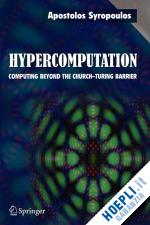
Hypercomputation is a relatively new theory of computation that is about computing methods and devices that transcend the so-called Church-Turing thesis. This book will provide a thorough description of the field of hypercomputation covering all attempts at devising conceptual hypermachines and all new promising computational paradigms that may eventually lead to the construction of a hypermachine.
Readers of this book will get a deeper understanding of what computability is and why the Church-Turing thesis poses an arbitrary limit to what can be actually computed. Hypercomputing is in and of itself quite a novel idea and as such the book will be interesting in its own right. The most important features of the book, however, will be the thorough description of the various attempts of hypercomputation: from trial-and-error machines to the exploration of the human mind, if we treat it as a computing device.
Apostolos Syropoulos holds a Diploma in Physics from the University of Ioannina, Greece, a M.Sc. in Computer Science from the University of Göteborg, Göteborg. Sweden, and a Ph.D. in Theoretical Computer Science from the Democritus University of Thrace, Xanthi, Greece. He has published papers in the areas of categorical semantics, natural computing, programming language theory, Web-oriented technologies, and digital typography.
In addition, the prospective author has presented his work in the workshop of the European COST Action Group 16 (Multivalued Logics) that was held in Vienna, Austria in 1998. He is also the team leader of the Greek Molecular Computing Group, which is a member of the European Molecular Computing Consortium, whose director is Professor Grzegorz Rezenberg. He was also member of the Democritus University team on Industrial Mathematics of the European Initiative on Mathematics in Industry. Last, but not least, it is worth to mention that recently the prospective author has published a book on the Perl programming language (in Greek).


Il sito utilizza cookie ed altri strumenti di tracciamento che raccolgono informazioni dal dispositivo dell’utente. Oltre ai cookie tecnici ed analitici aggregati, strettamente necessari per il funzionamento di questo sito web, previo consenso dell’utente possono essere installati cookie di profilazione e marketing e cookie dei social media. Cliccando su “Accetto tutti i cookie” saranno attivate tutte le categorie di cookie. Per accettare solo deterninate categorie di cookie, cliccare invece su “Impostazioni cookie”. Chiudendo il banner o continuando a navigare saranno installati solo cookie tecnici. Per maggiori dettagli, consultare la Cookie Policy.